Many children’s books are about lessons, or about establishing reality for young kids: this is a cat, this is a ball. Dr. Seuss (1903-911) wrote his share of lesson stories, but at core, his books are about questioning reality. Game designer Kenneth Hite once brilliantly referred to Dr. Seuss as “the USA’s greatest fantasist,” but he could just as easily have said, Dr. Seuss is a Dreamland creator.
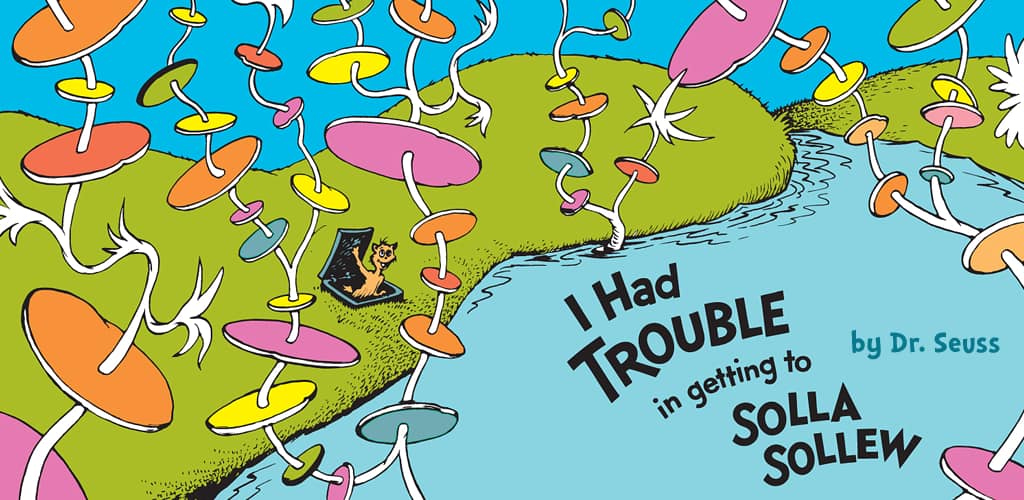
Seuss’s work doesn’t typically involve the framing structure of a dream (except for his great movie “The 5000 Fingers of Dr. T”), but it is nothing if not weird and dreamlike. Sometimes, as in “One Fish, Two Fish, Red Fish, Blue Fish” and “There’s a Wocket in My Pocket”, or even “The Cat in the Hat”, the strange invades familiar spaces: bizarre creatures in ordinary 1950s living rooms, interacting with stereotypical 1950s children. But just as often, the ‘normal’ protagonists go Outside, into faraway lands with weird names. They may go there like early 20th-century explorers, bringing back strange specimens and exotic foods (“If I Ran the Zoo,” “Scrambled Eggs Super”, “On Beyond Zebra”). Or they may already be inhabitants of this world, like the typically ambiguous furry Seuss-creature of “I Had Trouble in Getting to Solla Sollew,” whose quest for a magical city unintentionally parallels a certain Dream-Quest of Unknown Kadath. A sense of the Exotic pervades Seuss, going from his earliest works like the short-lived 1935 comic strip “Hejji” (set in a pseudo-Tibetan kingdom) to his final work, 1991’s “Oh, the Places You’ll Go!” As far as I can tell, Seuss didn’t read the fantasy fiction or Orientalist fiction of his day, so this influence must just have been in the air for a man born in 1903. Some of his earliest books like the Bartholomew Cubbins series do feature pseudo-European Medieval settings, but Seuss later dismissed this period of his work, saying he’d just grown up assuming that childrens’ books had to have castles and kings. Then he broke away from that, and got weird.
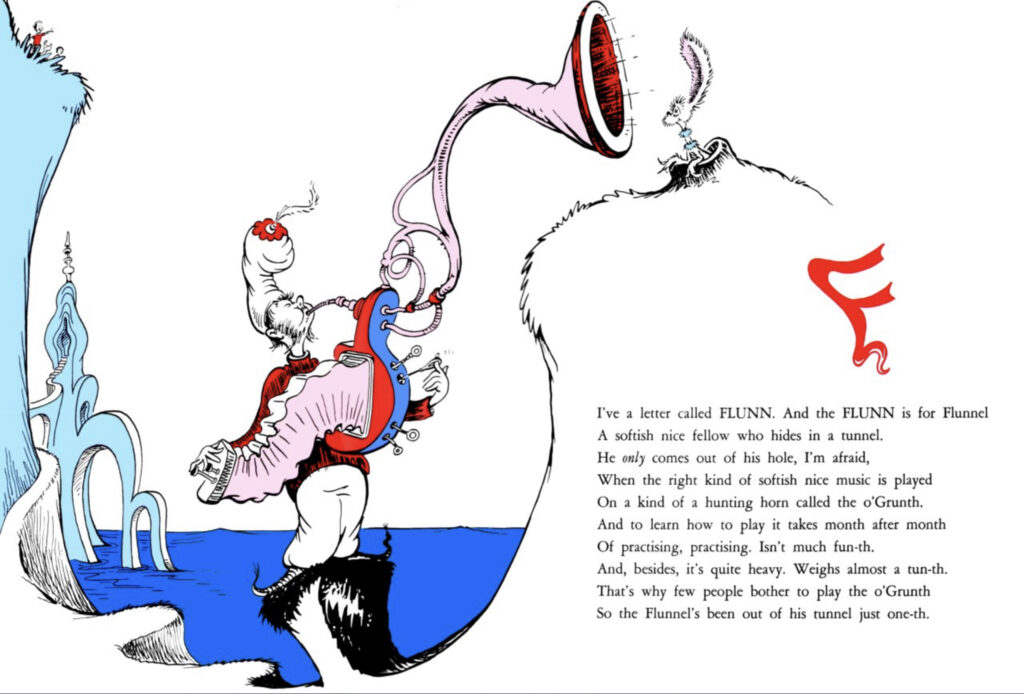
Dr. Seuss started his career as a college humor cartoonist, and created his pen name (real name Theodor Seuss Geisel) when he was doing a series of humorous make-believe animals: the “Doctor” gave fake gravitas, like a Doctor of Fantasy Zoology. Goofy creatures were an element in his work throughout his life, extending beyond his books to paintings and fake-taxidermy sculptures of mounted heads. The strange places came later, initially to create environments for the strange animals. More like Dunsany than Lovecraft in this regard, Seuss loved making up new weird names, usually concocting them whenever he needed to complete a rhyme. A typically contradictory 20th century white liberal (during WW2, when he worked for the US Army, he drew editorial cartoons against anti-Black racism while simultaneously drawing extremely racist anti-Japanese caricatures), he grew up speaking English and German, experienced some of the anti-German prejudice which was common in the USA in WW1, and lived almost all of his life in the USA. In 1970s Seuss and his wife went on a grand tour of the world, including several locations in Asia; this inspired him to sketch portions of a “Dr. Seuss Travel Guide” (not its actual name). It’s probably OK that he never completed this book, since it would surely have ended up as one of the several books de-listed by Dr. Seuss Enterprises in 2021, for offenses ranging from the frankly offensive racist stereotypes in “If I Ran the Zoo” and “And To Think That I Saw it on Mulberry Street” to the more ambiguously ‘exotic’ imagery in “On Beyond Zebra” (one of my favorite Seuss books, which I hope comes back into print someday). Even the 2021 crackdown couldn’t eliminate all the vaguely Islamic costumes and architecture in Seuss’s imaginary worlds, on display in works like “Did I Ever Tell You How Lucky You Are?” and “Oh, the Thinks You Can Think!”, among many others. (Perhaps even in the opulence of “Happy Birthday to You!”) A closer-to-home influence on Seuss’s scenery was the surreal desert backgrounds of George Herrimann’s comic strip “Krazy Kat”, which Seuss acknowledged as a favorite.
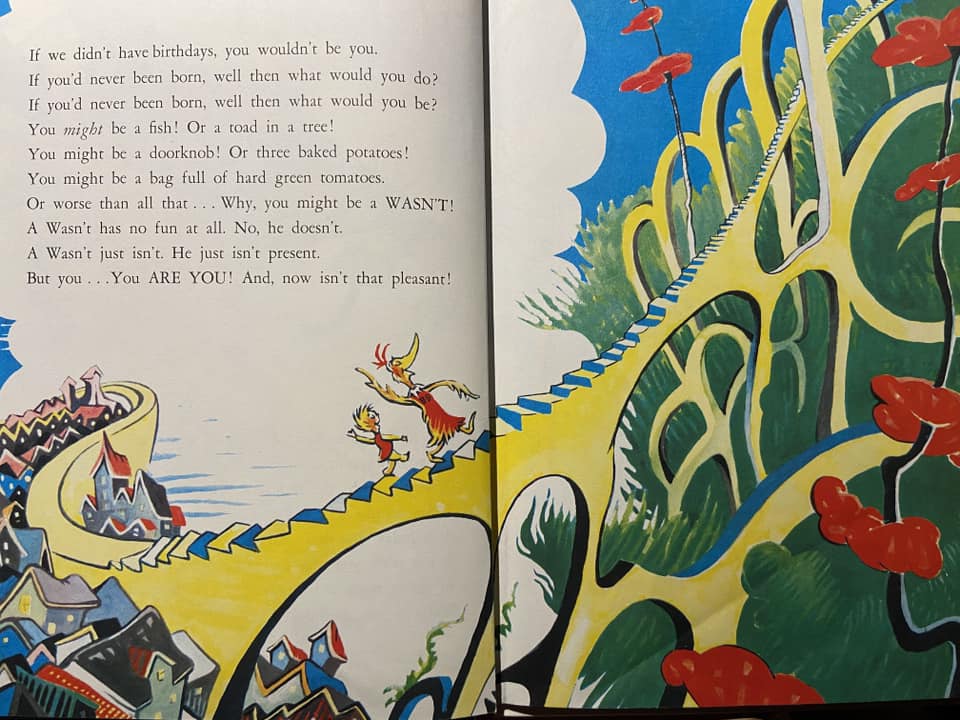
This, then, is the implied world of the works of Dr. Seuss. It’s a world where strange lands exist, pseudo-Oriental cities and jungles full of strange creatures. (To add to the confusion about where these places might be, consider that the entire setting of “How The Grinch Stole Christmas!” is so small it exists on the head of a pin, unless, as is likely, Seuss just couldn’t resist reusing the name ‘Whoville’ in two very different books.) It’s also a world with dystopian pipe-filled caricatures of modern cities, from the ruins of Ronk (from “Did I Ever Tell You How Lucky You Are?”) to the polluted wasteland where once lived the Lorax (“The Lorax”), to the nightmarish Terwilliker Institute (“The 5000 Fingers of Dr. T”). It’s a world of weird giant creatures; and humans who look like humans, and humans who look like bugs, or animals, or who knows. Like in Lord Dunsany’s various ‘thief’ stories (where Dreamlandish thieves are apparently hired by waking-world people to steal fantasy treasures from Dreamland), how you get from the Normal World to the Other World is unclear. But it is a weird world of faraway things, and in that way, it’s Dreamland.
The amazing Chris Jarocha-Ernst reached out to me and compiled a list of Seussian locations, broken down by story. The also awesome John Anderson later reached out to me and added some more names, including locations mentioned in the animated specials, for which spellings are hypothetical. I have slightly rearranged Chris’s original list to eliminate duplicate listings (of which there are only a few; Seuss rarely reused names) and to turn it into a d100 table, in case you want a random Seussian site for your roleplaying adventure. This list may be updated, and if you find more names in his works, let me know! The greatest thanks to Chris and John for all of this.
d100 Seussian Locations (by Chris Jarocha-Ernst & others)
And to Think That I Saw It on Mulberry Street
1 Mulberry Street (surely a gateway to the Dreamlands)
The 500 Hats of Bartholomew Cubbins
2 Kingdom of Didd (also appears in Bartholomew and the Oobleck)
The King’s Stilts
3 Kingdom of Binn (home of Patrol Cats)
4 Sambaland
McElligot’s Pool
5 McElligot’s Pool (same area as Mulberry Street [same narrator, Marco], so another gateway)
Bartholomew and the Oobleck
6 Mount Neeka Tave
If I Ran the Zoo
7 Island of Gwark
8 mountains of Zomba-ma-Tant
9 country of Motta-fa-Potta-fa-Pell
10 Desert of Zind
11 (African isle of) Yerka
12 Nantasket (near Persia)
13 Kartoom
14 Mountains of Tobsk
15 River of Nobsk
16 Jungles of Hippo-no-Hungus
17 Jungle of Dippo-no-Dungus
18 Jungle of Nippo-no-Nungus
Scrambled Eggs Super!
19 Mt. Strookoo
20 Fa-Zoal (10 miles beyond the North Pole)
21 country of Zummz
Horton Hears a Who!
22 Jungles of Nool
23 Who-ville (on dust speck; also appears in How the Grinch Stole Christmas!)
On Beyond Zebra! (narrator Marco again? looks like him)
24 Bazzim
25 North Nubb
26 West Bunglefield
27 Yupsler
28 Jounce
29 Ipswitch (the British town is “Ipswich” without a “t”)
30 Nipswitch
31 South Bounce
32 East Ounce (the preceding 8 entries are all stops on a transit line)
33 Gekko (a grotto)
If I Ran the Circus
34 Jungles of Jorn
35 country of Frumm
36 Brigger-ba-Root
37 West Upper Ben-Deezing
38 Soobria
39 Ocean of Olf
How the Grinch Stole Christmas!
40 Mount Crumpit (close to Who-ville, which is also mentioned in Horton Hears a Who!)
Happy Birthday to You!
41 Land of Katroo (same as Ka-Troo from If I Ran the Zoo, likely)
42 Mt. Zorn
Yertle the Turtle (Yertle the Turtle and Other Stories)
43 Island of Sala-ma-Sond
The Zax (The Sneetches and Other Stories)
44 Prairie of Prax
What Was I Scared Of? (The Sneetches and Other Stories)
45 Roover
46 River town of Grin-itch
Dr. Seuss’s Sleep Book
47 Country of Keck
48 Herk-Heimer Falls
49 Castle of Krupp
50 Culpepper Springs
51 Mercedd (out West; the city in California is “Merced” with one “d”)
52 Finnigan Fen
53 Valley of Vail
54 Foona-Lagoona
55 District of Dofft
56 Vale of Va-Vode
57 Far Foodle
58 Zweiback Motel
A Great Day for Up!
59 Mt. Dill-ma-Dilts
Dr. Seuss’s ABC
60 Quincy (has a Queen)
Hooray for Diffendoofer Day!
61 Dinkerville
62 Diffendoofer School
63 Flobbertown
The Lorax
64 unnamed town – Street of the Lifted Lorax
65 nearby North Nitch (close to Weehawken, possibly the township in New Jersey)
66 nearby South Stitch (see above)
Oh, the Thinks You Can Think!
67 Na-Nupp (has three moons)
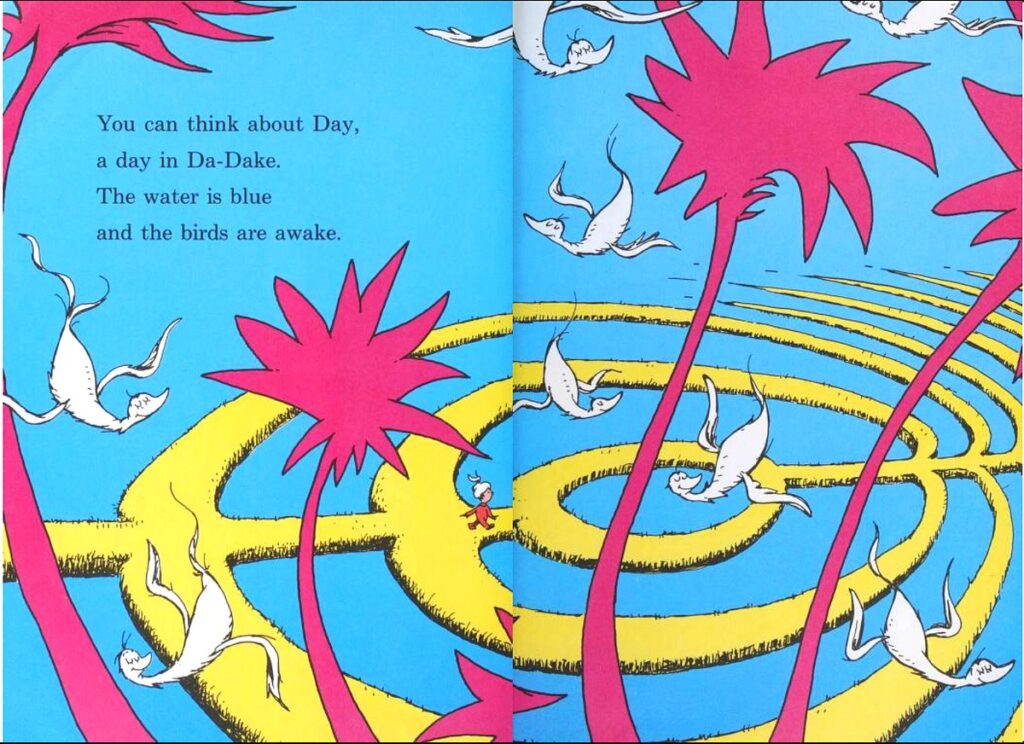
68 Da-Dake
69 Vipp
I Had Trouble in Getting to Solla Sollew
70 Valley of Vung
71 River Wah-Hoo
72 Solla Sollew (city)
73 Pompelmoose Pass
74 River Woo-Wall
75 Boola Boo Ball (city)
Did I Ever Tell You How Lucky You Are?
76 Desert of Drize
77 Boober Bay
78 Bumm Ridge
79 Bungleburg Bridge
80 Ga-Zayt
81 Ga-Zair
82 town of Hawtch-Hawtch
83 princedom of Poo-Boken
84Ruins of Ronk
85 Kaverns of Krock
86 Grooz
I Can Lick 30 Tigers Today & Other Stories
87 Katzen-stein
You’re Only Old Once!
88 Fotta Fa Zee
Hunches in Bunches
89 Gee-Hossa-Flat
The Butter Battle Book
90 Sala-ma-goo
The Cat in the Hat (Animated Special)
91 Bugu Bugu
92 Foda Foda
93 Glocca Morra
Dr. Seuss on the Loose (Animated Special)
94 Heights of Mooga Mooga
95 Gullies of Gazoo
Pontoffel Pock, Where are You?? (Animated Special)
96 Groogen
97 Casbahmopolis
The Hoober-Bloob Highway (Animated Special)
98 Batcha-Natchastan (attic of the palace is infested with tigers)
99 North Inzasquinzabo (inhabitants live in igloos)
100 West Watch-a-ka-tella (the “jackpot” of places to be born)
OTHER: Quoobland (“The Hoober-Bloob Highway”), Ponker’s Pond (near Whoville in “Halloween is Grinch Night”)
Great article. Dr Seuss creations haunt memories of my childhood. His worlds are as weird and distinct as the Mandelbrot Set
* Mt Strookoo (“Scrambled Eggs Super”)
* Gekko (Grotto in “On Beyond Zebra”)
* Ocean of Olf (“If I Ran the Circus”)
* Katzen-stein (“I Can Lick 30 Tigers Today & other stories)
* Grooz (“Did I Ever Tell You How Lucky You Are?”)
* Beft (“Oh the Thinks You Can Think”)
* Fotta fa Zee (“You’re Only Old Once”)
There’s some more places mentioned in the animated TV specials written by Seuss! (I’m guessing on the spellings for some of these)
(“The Cat in the Hat”)
* Bugu Bugu
* Foda Foda
* Glocca Morra
(“Dr Seuss on the Loose”)
* Heights of Mooga Mooga
* Gullies of Gazoo
(“Pontoffel Pock, Where Are You?”)
* Groogen
* Casbahmopolis
(“The Hoover Bloob Highway”)
* Batcha-natchastan (attic of the palace is infested with tigers)
* North Inzasquinzabo (inhabitants live in an igloo and milk a walrus)
* West Watch-A-Ka-Tella (the “jackpot” of places to be born)
* Quoobland (once had a queen with a wart on her nose)
(“Halloween is Grinch Night”)
* Ponker’s Pond (appears to be east of Whoville)
“A typically contradictory 20th century white liberal (during WW2, when he worked for the US Army, he drew editorial cartoons against anti-Black racism while simultaneously drawing extremely racist anti-Japanese caricatures) . . .”
Yes, SO typical of a White person to be against anti-black racism, while seeing no problem in being racist against a different group of people. I wonder, are you White yourself? I’m just curious!