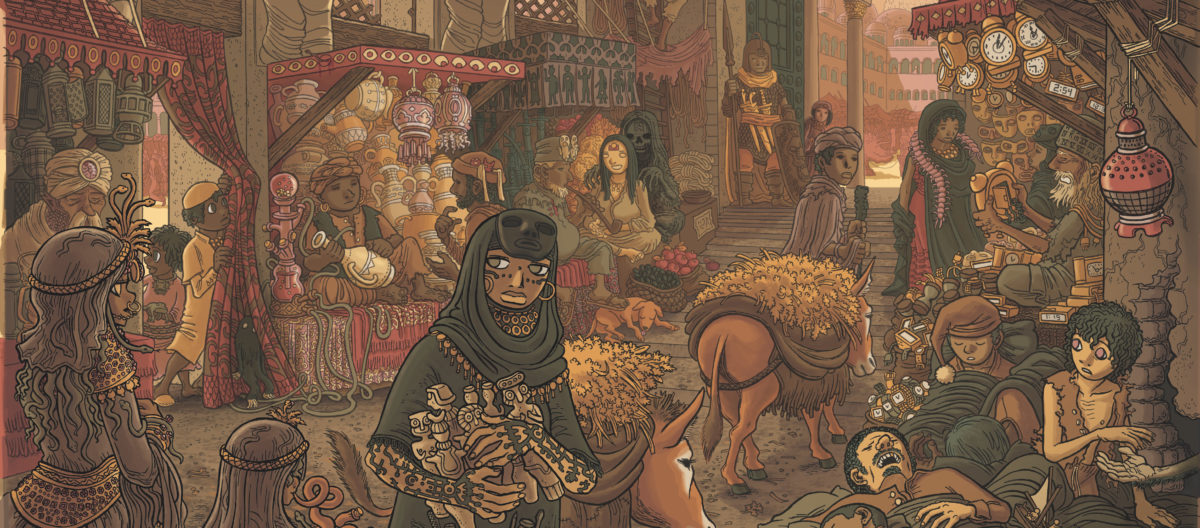
I’ve been drawing the Dreamlands in one form or another since way back in 1997 (!!!), when the first issue of my “Dream-Quest of Unknown Kadath” graphic novel adaptation was released. (Technically, I was drawing it even before that, since I was doing sketches for “Kadath” in high school.) When I first started writing the RPG back in 2014 (also !!!), I didn’t envision it as more than a small RPG zine of 48 or so pages. Things have changed and, as is usually the case with projects I love and obsess over, the project has grown considerably. Exalted Funeral, the publisher of the game, has always been enthusiastic about my artwork and what was originally going to be a sparsely illustrated project has grown into a work with over 100 color illustrations.
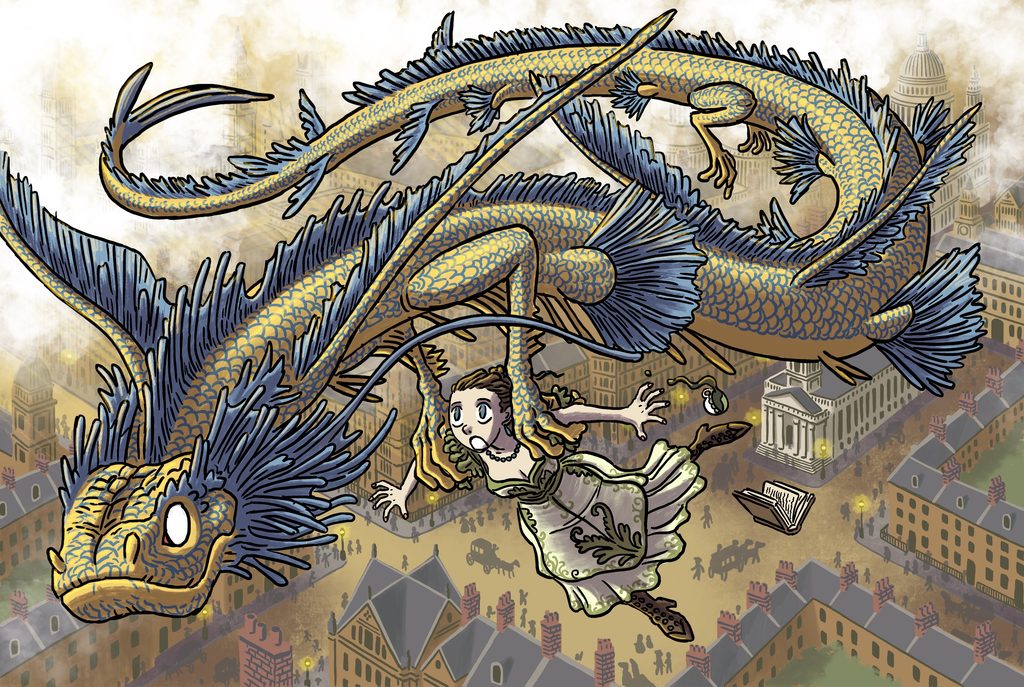
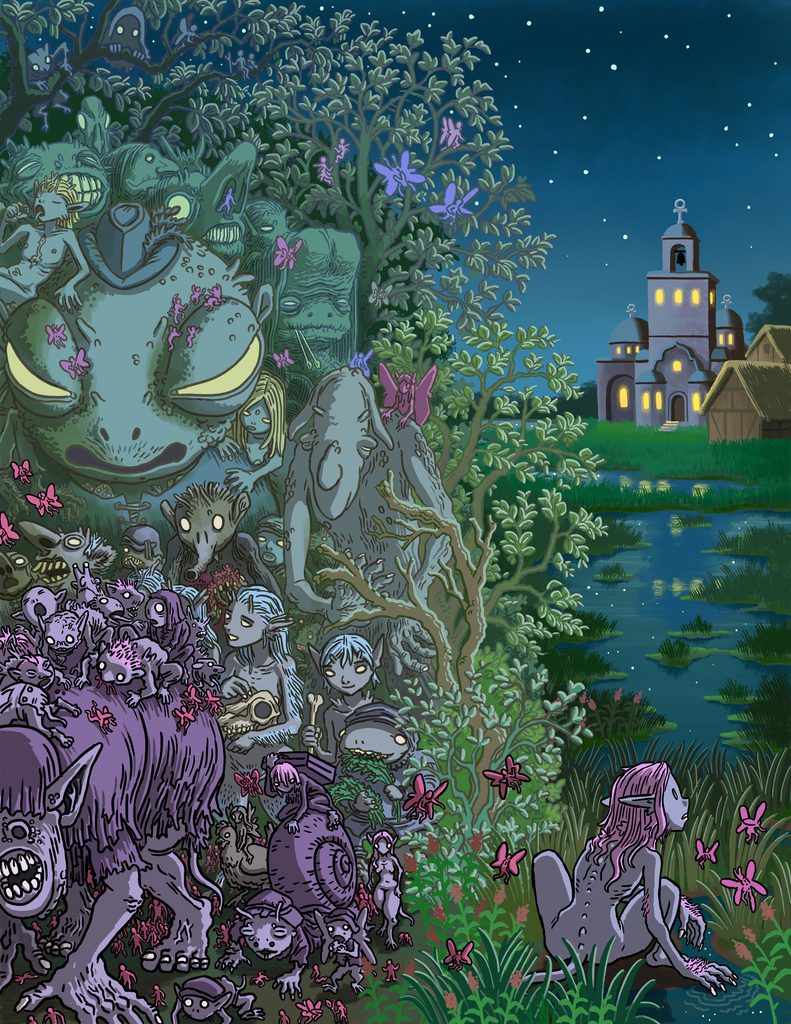
The first drawing I made for Dreamland did double-duty as the cover for “Monsters,” a 2015 comics anthology put out by my friends at the Couscous Collective. Titled “The Gathering of Beasts,” it depicts a meeting of fairies, centaurs, snakes, dogs, cats, dragons and some of the other important creatures of Dreamland. At the time I was busy with other projects and it was a long time before I could really dig into playtesting and writing Dreamland, so it wasn’t until 2019 that I completed the second Dreamland illustration, another two-page spread showing a city, which I printed and displayed at the art show for NecronomiCon 2019. The third Dreamland illustration was another double-duty drawing: a Dreamland wizard sitting next to a red dragon, while night-gaunts fly in the distance. In this case, the basic concept was suggested by Paul MacLean, podcaster and longtime manager of The Attic and the former Yog-Sothoth dot com forum, who commissioned it as a cover for a journal he was printing. Paul, always hospitable and generous to the gaming community, graciously consented to let me reuse it for Dreamland.
One thing all these early drawings shared was a sepia-toned, limited color palette; for the initial “Beasts” illustration I copied a color palette from Charles Vess. For most of my life as an artist I resigned myself to just not being very good at color; it’s no accident that I started out drawing B&W indy comics and that I love manga, which is typically in B&W. The few color pieces I had to produce in my early career, like the covers for the Dream-Quest five-issue comic series, were clunky at best. When I met my spouse in 2009, they often helped with my coloring (including coloring the cover of my 2012 Dream-Quest graphic novel reprint) and generally inspired and taught me. Getting my iPad and learning ProCreate, whose color tools are much more intuitive than Photoshop, has also been a huge help. For years, I would pick a palette and cling to it like a drowning man clinging to a piece of driftwood, but gradually I’ve dared to experiment more. The last three years of drawing Dreamland artwork have been the largest time investment I’ve ever put into coloring and developing my color skills.
In the process of making the game, I’ve also gathered and thought about a ton of other artists’ work that I consider ‘Dreamy’ and that has given me ideas for the Dreamlands. (I’ve posted many particular images on the Dreamland Facebook group, which I’ve used as a kind of giant image/inspiration board. My baseline artistic influences are mostly old manga and other 20th century comics, but I have also been very inspired by children’s books and fairytale artwork. The 1970s in particular saw a boom in incredibly unique fantasy artists (and I’m also nostalgically attached to the era since that was the art when I was a kid of course). To list just one of many great 1970s fairytale anthologies, the artist list of Idries Shah’s collection World Tales has been a Bible to me, Googling the many artists featured there to see what they did and what they became.
At the risk of sounding like some toddler with a toy xylophone saying they’re inspired by Mozart and Beehoven, here’s some particular artists who have inspired me to draw art for Dreamland:
* Gervasio Gallardo. Pseudo-surrealist illustrator who did many great covers for the Ballantine Fantasy paperbacks books in the 1970s.
* Dr. Seuss. As a kid I was just immersed in his work since it was everywhere, as an adult (and a parent) I appreciate the weirdness of his art and his bizarre worldbuilding.
* Mercer Mayer, specifically “Professor Wormbog” and “One Monster After Another.” His beautifully illustrated early work.
* Francois Schuiten & Benoit Peeters’ “Obscure Cities.” I can’t dare say that I’ve learned anything from Schuiten’s art, which is just so skilled and so high above my level (and also more realistic than I’d want to draw, honestly…). But the world they built is fascinating.
* Luka Rejec. Stunning color, amazing SF/fantasy worldbuilding and art, and he’s also a multiclass RPG creator/artist/writer!
* Shaun Tan. Another just amazingly talented artist.
* Sidney Sime. Lord Dunsany’s illustrator/collaborator, and a true genius. More a B&W than a color artist, I love his proto-surreal Symbolist illustrations.
* Gilbert Williams. Artist of pop New Age posters of glowing lights, grassy knolls, waterfalls, giant crystals etc. I feel I have to apologize for liking his work, since it is only a few steps over from Thomas Kinkade, but I’ve always had a soft spot for this kind of fantasy art.
* Arthur Rackham. Obviously a genius. Also Edmund Dulac. These are the main two names I remember from the great Victorian/Edwardian fairytale illustrators… oh! Also Charles Robinson! (But Dulac and Rackham did more color.)
* Alan Aldridge. One of the great 1970s album/book illustrators, along with Roger Dean, etc.
* Hayao Miyazaki and Studio Ghibli, of course. I could look at their drawings of grass for hours.
* Una Woodruff. An amazing (fantasy) botanical and zoological illustrator who left behind two great works, Inventorum Naturae and Amarant.
* Nicholas Roerich for colors.
* I’ve also shamelessly dug around into 19th century Orientalist art for scenery and costume reference material, digging through that problematic treasure trove.
There are probably many other artists who I’ve imitated or been inspired by whose names I can’t remember just now.
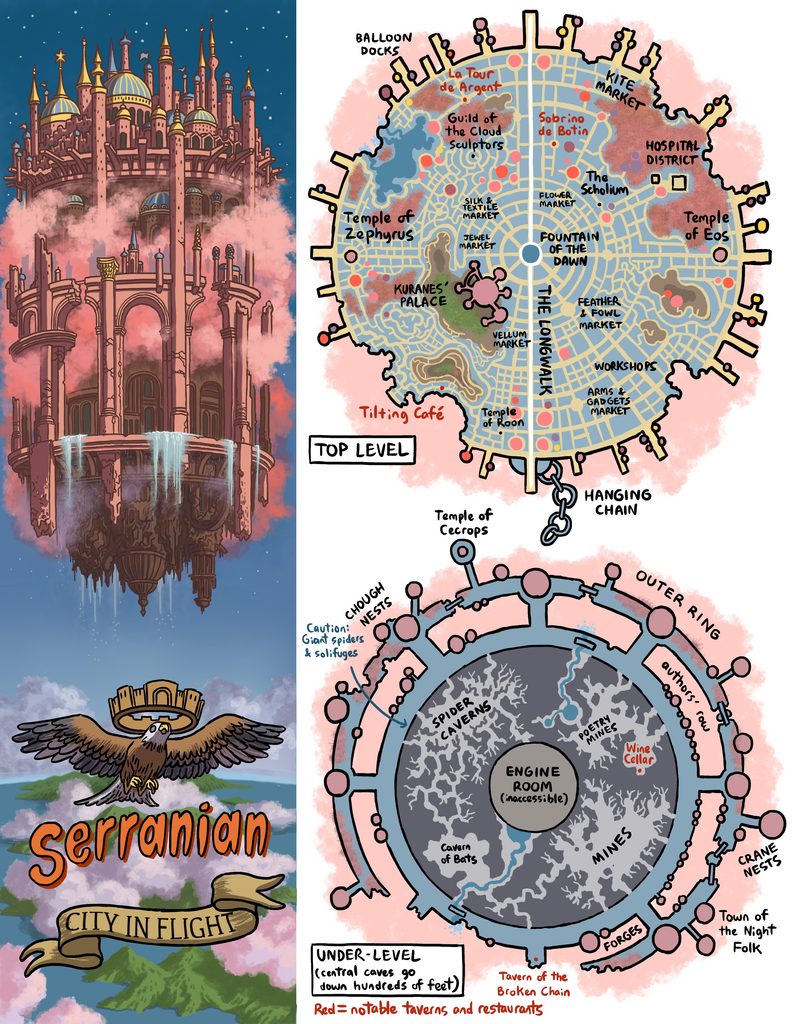
Thematically, Dreamland the RPG is also a sequel to my Dream-Quest of Unknown Kadath graphic novel, so it has been interesting returning to drawing many of the same subjects. I always envisioned Dreamland as its own thing that is broader than Lovecraft (and indeed the first draft of the game had few directly Lovecraftian elements in it besides night-gaunts) but while illustrating the Dreamland rules and setting book, I got to draw places like Ulthar, Dylath-Leen, and the Enchanted Wood for the first time in more than 15 years. (And I got to draw lots of new places which didn’t appear in my graphic novel, like the Forest of Parg, which apparently hardly anyone has drawn before.) In some cases I kept things the same, like ghouls and gugs. In other cases my concepts of things have changed, as with ghasts, shantak-bids and Lengites, or the town city of Ulthar, which looks different in part due to the contributions of my setting book cowriter (secret identity TBA!). In general, though, the graphic novel and the game can be considered to be in the same universe, so many things look alike and are just updated by my evolving artstyle. For better or worse, compared to the graphic novel, I also ditched the concept that “dreamers look like stick figures when they’re in the Dreamlands” (at least to themselves)… but stick figures do appear in the how-to-play-the-game comics scattered throughout the RPG, as an injoke for folks who’ve read the graphic novel, and now for you, reading this blogpost.
If you’ve been waiting for Dreamland and wondering “When is that game coming out???”, the main holdup has been me taking my time to complete all these illustrations for the books in the Dreamland boxed set. I hope you’ll stick around a little longer and that you like the look of the game when it’s released in 2027.