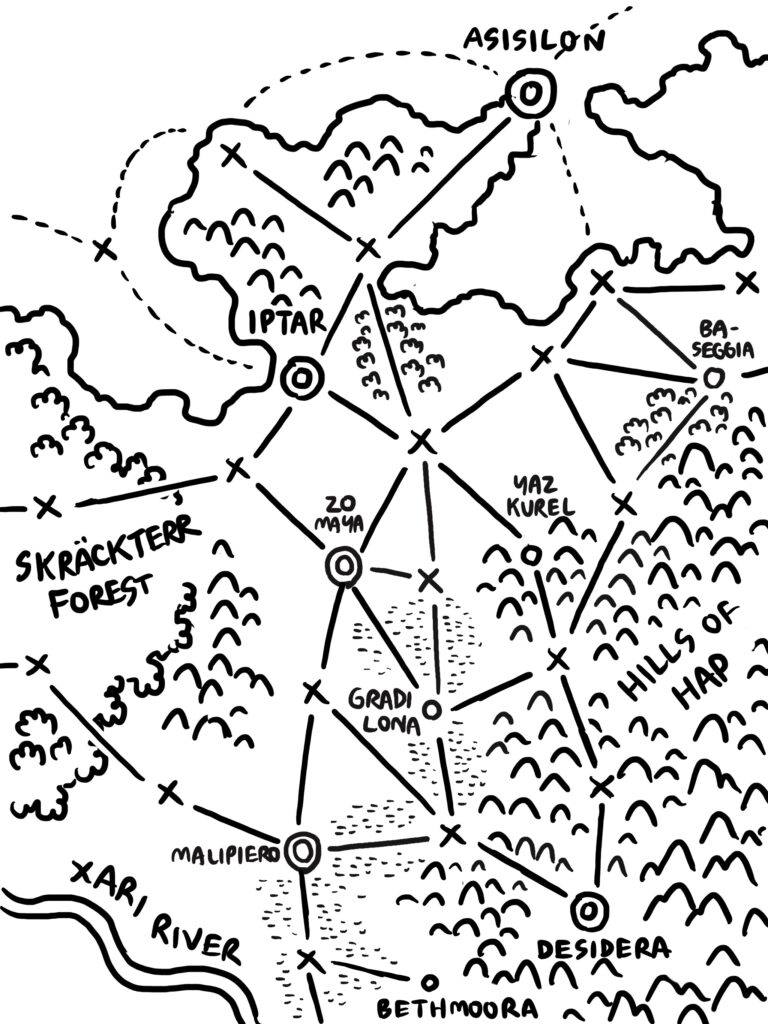
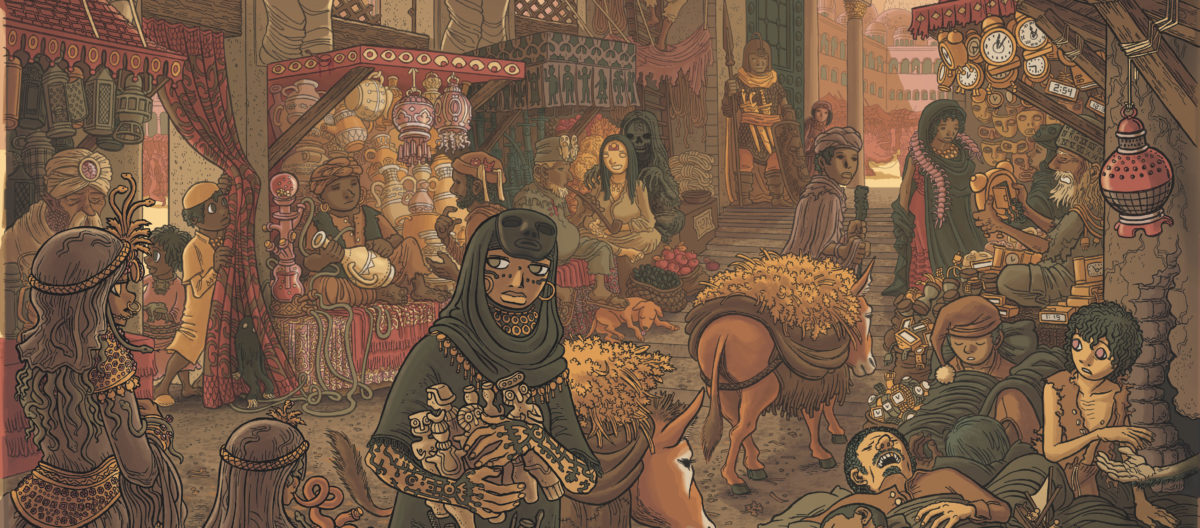
This blogpost was written in celebration of reaching 375 members on the Dreamland Discord server. I originally said that I would post about another setting, “The Land of the Seven Dreamers”, but upon reflection I realized that setting wasn’t ready to show, even in an abridged preview form. Instead, here is some information about Amadis, the setting of the Dreamland playtest adventure “The Love of Asisilon.”
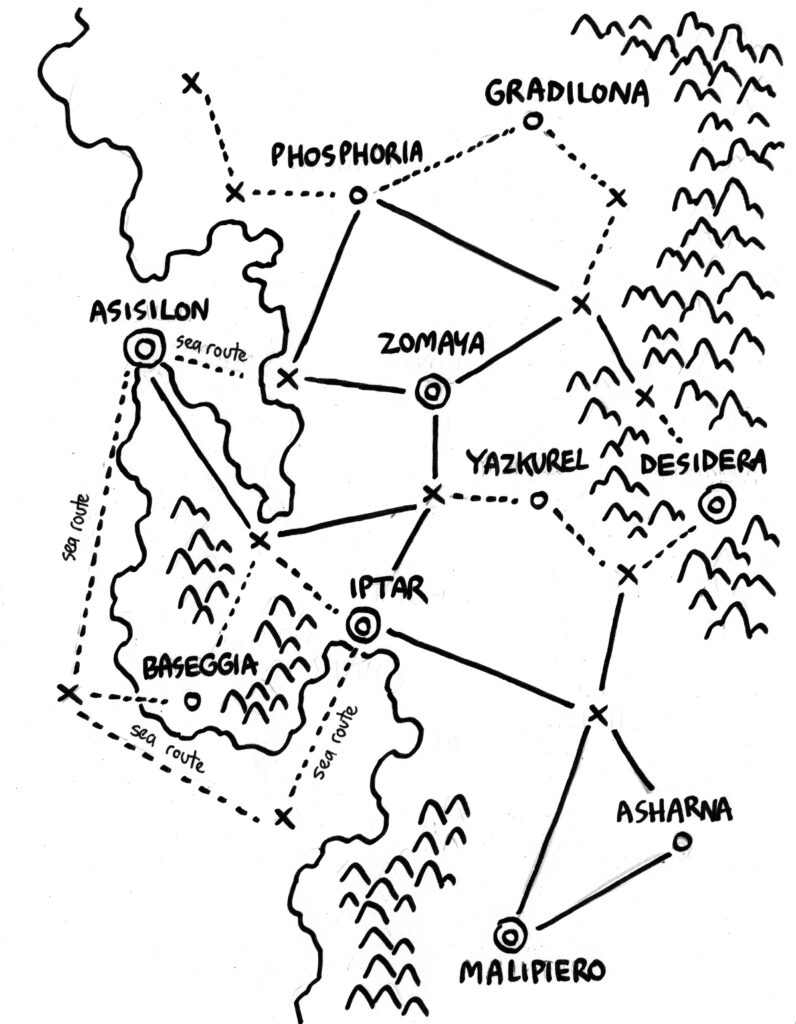
(Above is the first drawing of Amadis, then unnamed, circa 2019)
Amadis is a dry, temperate coastland, stretching from the sea in the west to the Mountains of Hap in the east. Like the Five (formerly Six) Kingdoms across the sea, it is a prosperous land without open war, and more fortunate than those gods-cursed kingdoms, though not without intercity plots and brigandry. Ruins of an ancient civilization — statues, ruined shrines, a great aqueduct — scatter the land, but none know who these people were, unless perhaps the Gradilonans or Malipierans know and keep the secret. The land is dry and yellow-tan in the summer, but the winter brings rain and turns the great coastal plains to green.
Asisilon (the biggest city in Amadis), “city of poets,” is a beautiful port city of baroque wood and stone houses, interspersed with gardens and parks. Every morning, fog from the sea blankets the city, but it usually retreats by noon. It is a trading city, and the harbor is always crowded with foreign merchant ships with colorful sails. Seven hills dominate the city: Fin Hill, Garden Hill, Silk Hill, Spoon Hill, Parrot Hill, Temple Hill and Gold Hill. The great Poetry Competition of Asisilon draws visitors from many lands. The people are well-regarded, though when their temper is aroused, they sometimes execute criminals in a mob attack with shards of pottery and broken coffee mugs.
Iptar, the only true rival to Asisilon’s status as greatest city, is an ugly city of tall gray towers. It is famous for the production of magical idols, of which each adult citizen owns one, treating it as their greatest treasure. Iptaran idols can speak, and are constantly in communication with a mystical power, passing messages from one Iptaran to another, singing songs, or relating historical and scientific information and other lore. However, they also listen, and having a mind of their own they will sometimes share Iptarans’ personal secrets, allowing those unfortunates to be mocked and shamed. In addition to their idols, the Iptarans are also captains of other industries, forging weapons and many other useful tools from steel.
Yazkurel is a small abbey, the home to powerful female mystics since time immemorial. These orange-skinned women are said to be the strongest people in the world, and as they are also cannibals, their neighbours treat them with fear and respect. The abbey contains ancient libraries and a shrine to Trogool, the Thing Which Is Neither God Nor Beast. Yazkurites reproduce transactionally by mating with outsiders, keeping the female children (who are always orange) but giving away the males.
Zomaya is visible from a great distance, a city of glittering, crooked crystal towers. From a distance it looks like a shining wisp of down. Up close, though, the city is hideous: the doors are too misshapen to enter, the stairways and floors crooked, the ground covered in black asphalt under a red sky. The Zomayans themselves, though tall, are as physically twisted as their city, which is the way it is because of its unusual architecture: rather than burning cities down, the Zomayans burned their city up from the soil, using a secret chemical reaction which causes the malfomed buildings to rise out of ash. The fire-scientists of Zomaya also know other secrets of science.
Gradilona is inhabited, but is not truly a city: rather, it is an cyclopean ancient factory, many miles wide, fallen into ruin. Within this tumbledown structure (sometimes hundreds of feet high) live the Gradilonans, a short, androgynous people who wear tattered blueprints and tarpaulins for clothes. Living on edible ferns and other plants grown within the ruined warehouses, as well as the occasional rat, the Gradilonans guard the location of many strange rooms within their complex, where (say outsiders) might lie treasure or secrets of the long-lost builder-gods.
Asharna is a town in motion, consisting of colorful tents carried on horseback by the nomadic Asharnans. All Asharnans are male, and almost always handsome; they love horseriding and wine (which they make from desert cacti) and poetic tales of courage and honor. Exclusively attracted to other men, they reproduce by composing special love poems which, when read aloud by knowing women who wish to become pregnant, induce pregnancy with an Asharnan child. Those willing to become mothers to Asharnans win the greatest respect from these people, and are usually paid for the surrogacy with great gifts of horses, wine or jade.
Phosphoria is another mobile ‘city’, a pop-up, a true myth. These few hundred nomads forever travel westward, following the legend of Phosphoria, the most beautiful city, the “city of the sun.” They believe that Phosphoria is on the sun itself, and their goal is to catch up to it at the point in sunset when it touches the horizon, and then climb on. Attracting converts as they go, they roam perhaps forever, the young and newly converted caring for the oldest pilgrim who have become blind and weatherbeaten from continually looking at the holy sun.
Malipiero, far inland, is dominated by a great cemetery of menhirs. Above the city gates is carved the word “autocthonous” (risen from the earth), as the dour stonecarving Malipierans believe they were birthed by the earth itself and much return to the soil of their homeland when they die. Indeed, if a foreigner is buried near Malipiero, the grave soon spits up their bones, pushing them to the surface where they are eaten by wild dogs. They fear and hate the sea, and have legends of battles between the evil Sea and the holy Earth.
Baseggia is a town of beautiful gardens, including cabbages 15 feet wide. A romantic getaway for neighboring cities, it it is inhabited natively by Baseggians, a short childlike folk who are birthed from plants and picked by their fellows when the time is right. The local cuisine is based on giant earthworms, moles and caterpillars.
Desidera, with its tall pink and lavender domes, rises above the snowy mountains like alpine flowers. Above the city gate is a carving of an enormous baboon. The Desiderans worship the idea of the past, and the city is filled with museums (or rather storehouses) stacked with bones, broken pottery and every old thing the Desiderans can find. Whenever a building collapses from age they stubbornly rebuild it in the exact same way but even taller, so the oldest towers in the city are perilously tall. Xenophobic and hostile to their neighbors, they use the latest technology for building, mining and war, but always complain constantly about having to do so.
These are the largest cities and towns of Amadis, although there are many other shrines and other curious sites in isolated paths and at the crossroads. Below is a more current drawing of Amadis, from 2023, which I’ll eventually be coloring (and revising!) when it’s ready to appear in the RPG.